How to tell the drainage field has failed rather than the tank, the three tests new ground must pass, and what to do when the plot will not take one.
At KP Cesspool Services, a failed drainage field is the most expensive fault on a septic system and the one owners most often pay to treat as something else. The tank gets emptied, the problem goes away for a fortnight, and it comes back. Emptying a tank that is backing up because the field will not take the water buys you a few weeks and fixes nothing. This is how to tell the difference, what new ground has to pass before a replacement field is allowed, and what the options are when the plot will not take one.
Drainage field, soakaway, leach field, same thing
The names are used interchangeably and it causes confusion. A drainage field is a run of perforated pipe laid in trenches of stone, taking the liquid that leaves the septic tank and letting it soak away into the ground. Soakaway is the older word and you will still hear it. Leach field is the American one.
Whatever it is called, it is doing the actual treatment. Soil bacteria break down what the septic tank only settled out. The field is not a hole for water to disappear into, it is the second half of the system.
Telling the field apart from the tank
The two produce similar symptoms indoors, which is why they get confused. Outside they look nothing alike.
A tank problem tends to be sudden and it clears when the tank is emptied. Drains slow up, an empty sorts it, and it stays sorted for months.
A field problem is gradual and it comes back. The empty helps for a week or two, then the same symptoms return. Along with that you get the signs that only a field gives you. Wet or spongy ground over the field in dry weather. Grass that is greener and grows faster in a rectangle you can trace. Standing water or a smell over the trenches. And the giveaway, symptoms that are noticeably worse in winter and better in summer, because a saturated water table leaves the field nowhere to send anything.
If the empty stops working sooner each time, it is the field.
Why fields fail
Three causes account for nearly all of them.
Sludge carry over is the big one, and it is preventable. When a septic tank is not emptied often enough, solids stop settling and pass through to the field, where they clog the stone and the surrounding soil. Once the trenches are blinded with solids, water cannot get out. This is the reason an annual empty matters, and it is the reason a collapsed or missing dip pipe inside the tank is a much bigger fault than it looks.
Age is the second. Fields do not last forever. The soil around the trenches gradually loads up with biological matter, and a field installed thirty or forty years ago on a household that has since doubled in size is being asked to do more than it ever could.
Ground and water are the third. On the heavy clay of the Kentish Weald a field works hard from the day it goes in, because clay drains slowly. On the low ground of Romney Marsh a high winter water table can submerge the trenches outright, at which point there is no unsaturated soil left for the discharge to pass through.
What new ground has to pass
You cannot simply dig a fresh field where the old one was and hope. The ground has to be tested first, and it has to clear three separate minimums.
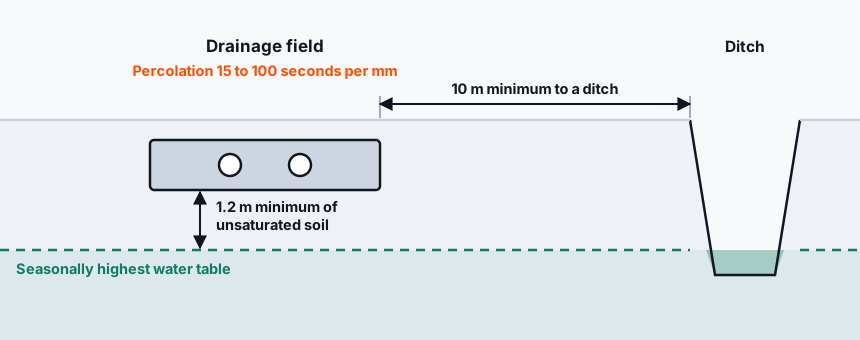
A percolation test tells you how fast the soil takes water, and the answer has to fall inside a window rather than simply being fast. Too slow and the field cannot cope. Too fast and the liquid runs straight through without the soil treating it, which is why gravel and fissured chalk can fail for the opposite reason to clay.
The water table clearance is the one that catches people out, because it is measured at the seasonal worst and not on the day the hole is dug. Ground that looks perfectly dry in August can be a metre wetter in January.
The distance to a watercourse is the simplest of the three and the least negotiable. If the plot cannot give you ten metres, that part of it cannot hold a field.
When the ground will not take another one
This is a common answer around here and it is worth hearing early rather than after a failed test and a wasted trench. If the percolation is out of range, or the winter water table is too high, or there is nowhere on the plot that clears the watercourse distance, a replacement field is not the fix.
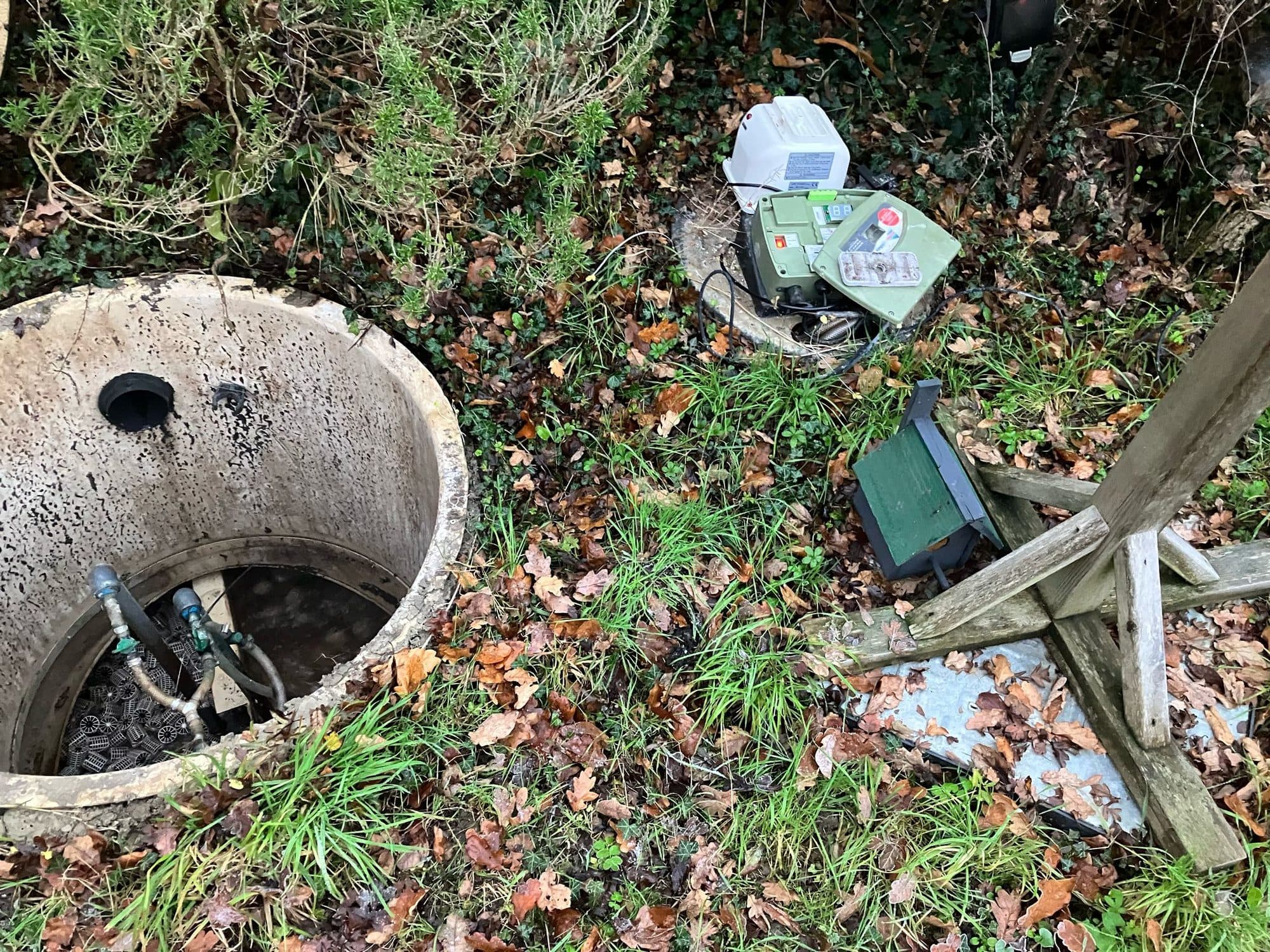
The answer then is a sewage treatment plant. A plant treats the waste properly rather than relying on the soil to do it, so what leaves is clean enough to discharge to a ditch or watercourse. It needs power and it needs servicing, but it works on ground that will not take a field at all. That is covered on our treatment plant installation page, and the related question of what a septic tank may and may not discharge into is set out in can a septic tank discharge to a ditch.
What a replacement actually involves
Testing first, always. Percolation holes, a look at the winter water table and a measure of the distances available on the plot. That is what decides whether the rest of the job is a field or a plant, and doing it in the wrong order is how people end up paying for both.
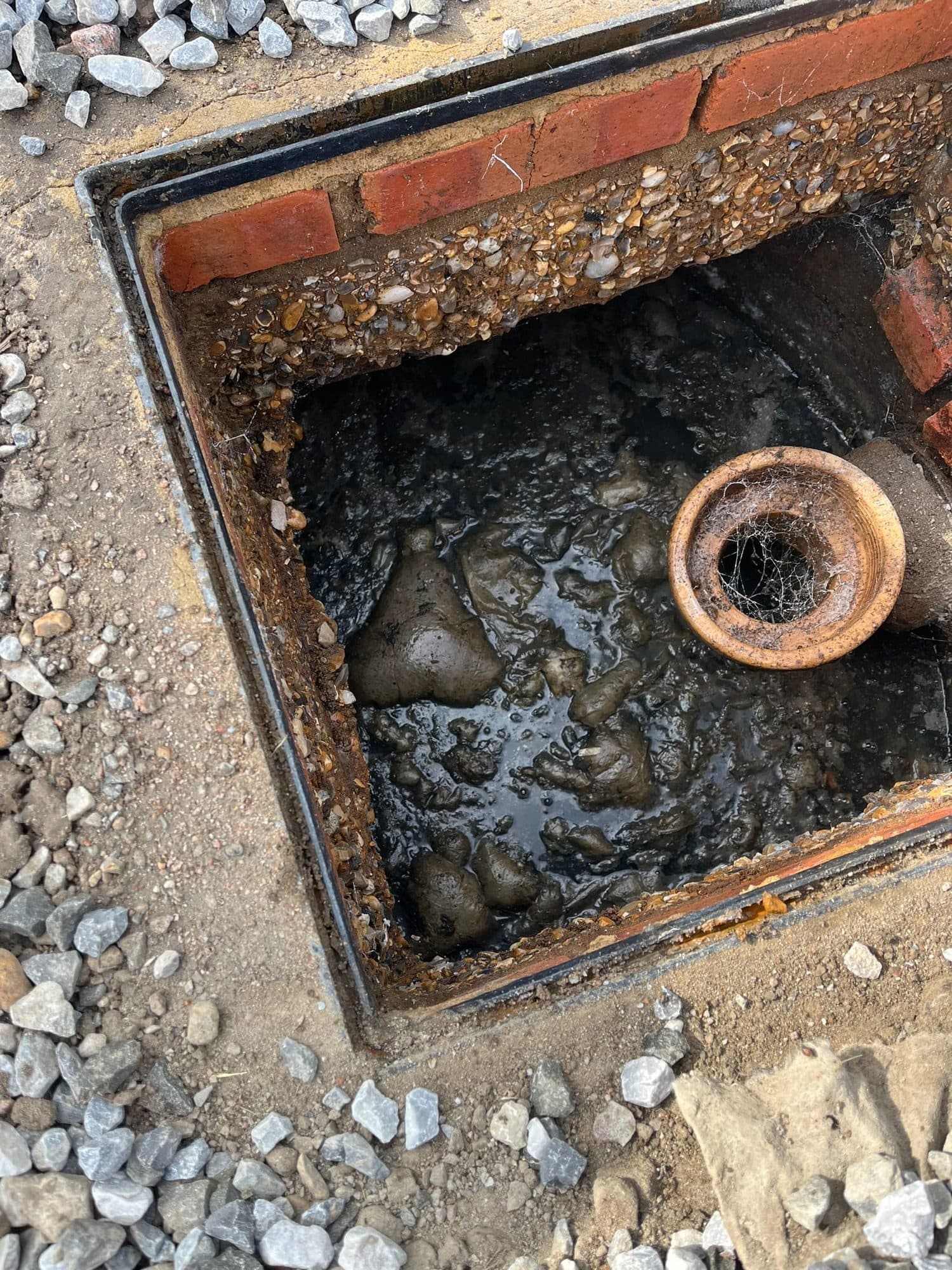
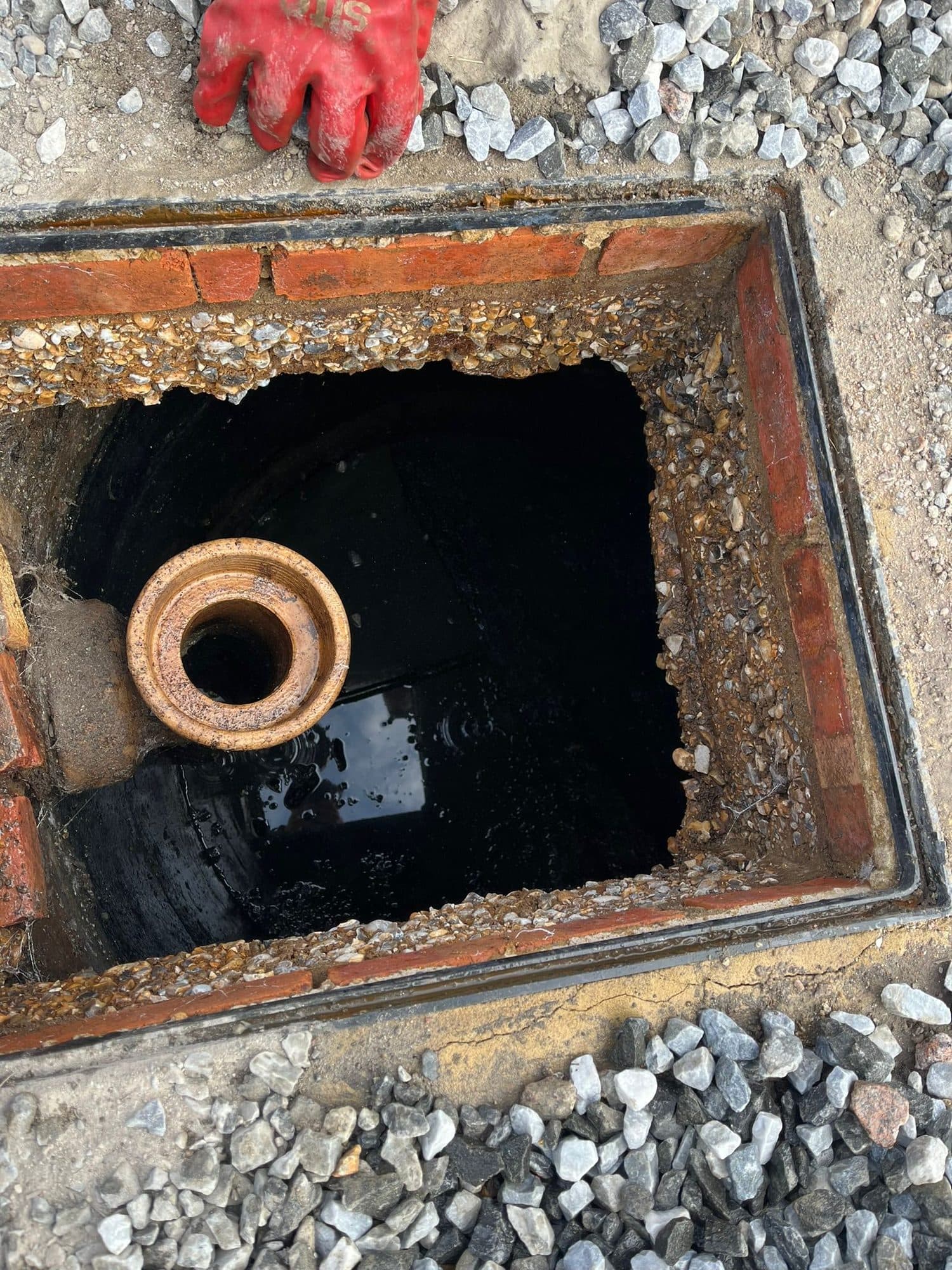
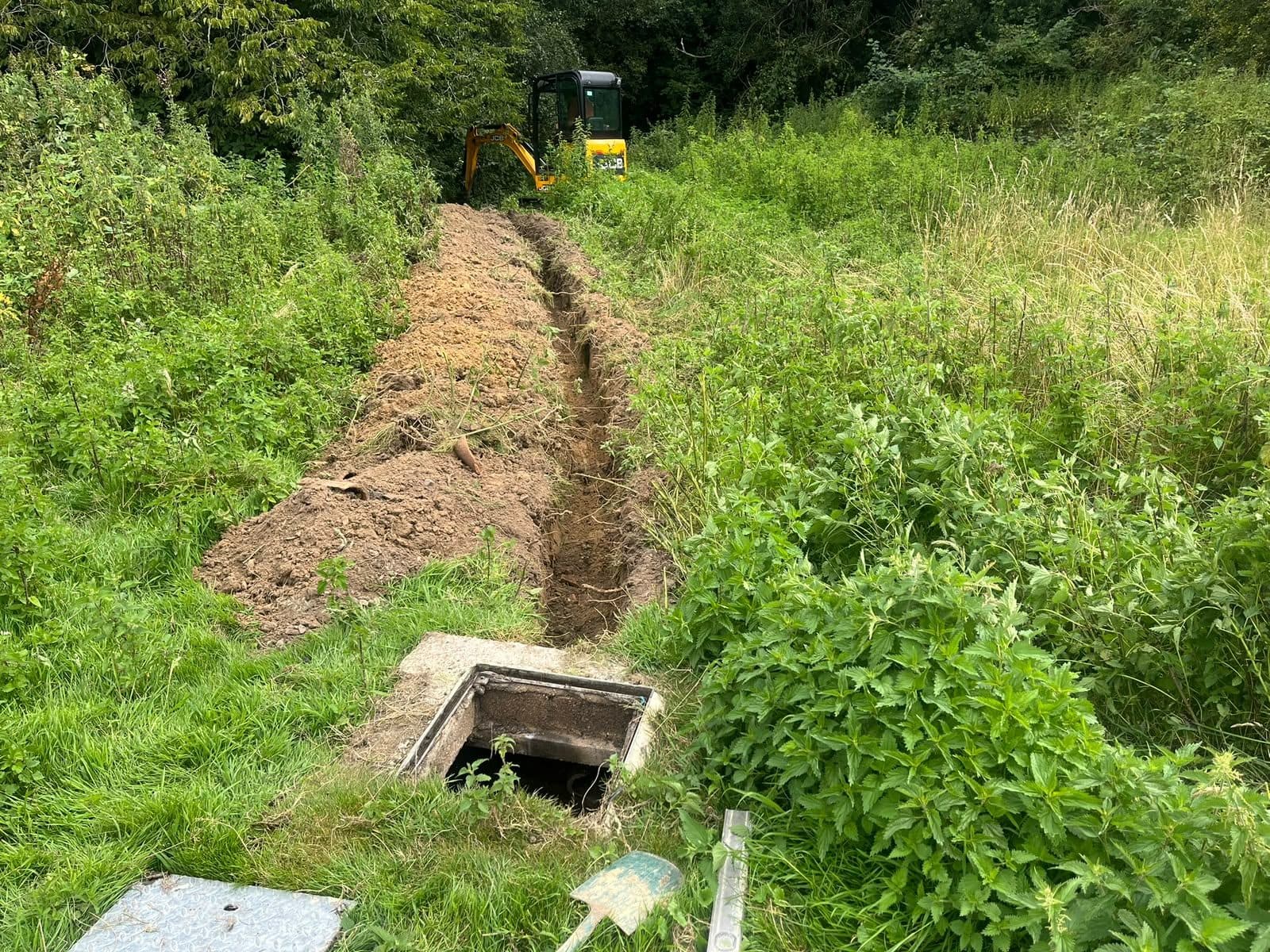
Then the groundworks. The old trenches come out or are abandoned in place, new trenches are dug to the depth and fall the test results allow, perforated pipe is laid in washed stone, and the whole run is covered and reinstated. The tank itself is emptied and inspected on the way through, because sending a new field the same sludge that killed the last one is a short road back to where you started.
We handle the excavation, the pipework and the reinstatement ourselves. See new tank installations for the groundworks side.
Keeping the next one alive
A new field has a much longer life than the one it replaced if three things happen.
Empty the tank on a proper interval, once a year for most households, so solids never reach the trenches. Keep wipes, fats and heavy bleach out of the system, because the first two clog and the third kills the bacteria doing the work. And fix dripping taps and leaking cisterns, since every litre of clean water going into the tank is a litre the field has to get rid of for nothing.
Do not park on it, do not build over it and do not plant trees near it. Compaction and roots finish fields off faster than sewage does.
Getting the ground tested
If your empties are not lasting, get the field looked at rather than booking another one. We will lift the covers, look at the tank and the outlet, walk the field and tell you which of the two you are actually dealing with.
Ring us. If it turns out to be the tank we will say so, and that is a much cheaper afternoon for you.