Need cesspool emptying in Rye? Learn typical emptying intervals, local drainage challenges and when to book your next visit.
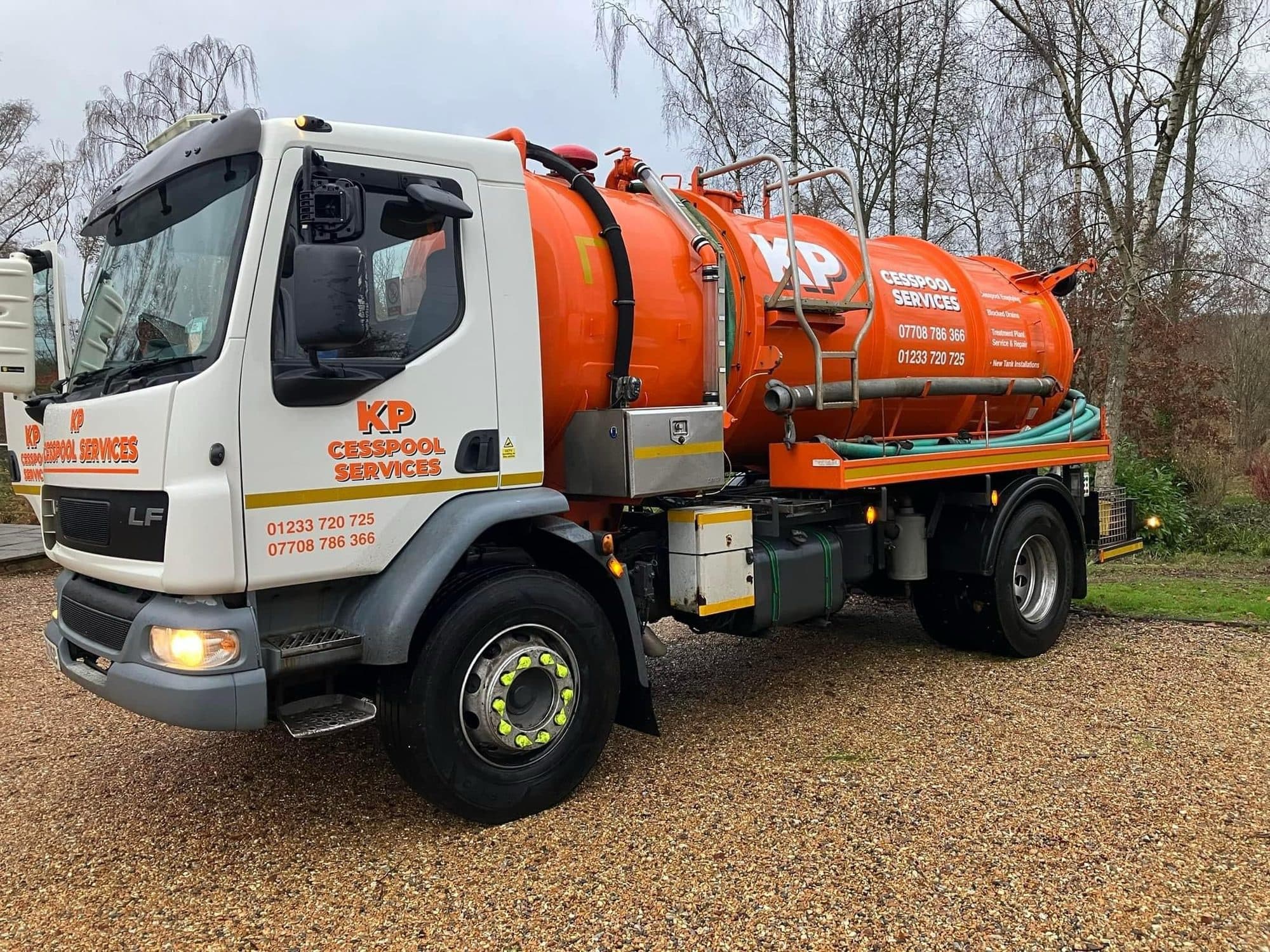
Most domestic cesspools in and around Rye need emptying every four to eight weeks, the visit itself is normally under an hour once a tanker is on site, and the waste has to be taken away by a registered waste carrier and delivered to a licensed treatment works. KP Cesspool Services covers Rye and the villages around it, from Playden and Iden across to Camber, Winchelsea and Rye Harbour, with scheduled cesspool emptying, one-off visits and a 24/7 emergency service for tanks that are already backing up.
Frequency is the part that catches people out, and the reason is that a cesspool has no outlet. It is a sealed holding tank, so nothing is treated and nothing drains away. It fills at almost exactly the rate you use water. Approved Document H of the Building Regulations assumes 150 litres per person per day when sizing one, and sets a minimum capacity of 18,000 litres for two users plus 6,800 litres for every additional person. Work that through and a cesspool built to today's minimum holds roughly seven to eight weeks of flow for the household it was designed for. In our experience, the tanks we empty around Rye are usually older and considerably smaller than that minimum, which is why a four to six week cycle is far more common here than the regulations imply.
Why so many properties around Rye have a cesspool at all
A cesspool is the most expensive private drainage system to run, so it is almost always installed because nothing cheaper will work on the site. Around Rye that happens far more often than in most of the country, and the reasons are geographical rather than historical.
A septic tank or treatment plant that discharges to ground needs a drainage field built to BS 6297, and a drainage field needs three conditions that the Rye levels rarely provide together. There has to be at least a metre of unsaturated soil beneath the pipework, even at the seasonal high point of the water table. The soil has to percolate within a workable band, broadly 15 to 100 seconds per millimetre. And the field has to sit at least 10 metres clear of any watercourse or ditch.
On the levels either side of the Rother, the water table sits high through most of the winter, the alluvial silt and clay percolates slowly, and the land is drained by a dense network of ditches. From working with clients on properties around Iden, East Guldeford and the Rye Harbour road, we've found that a single site can fail all three tests at once.
There is a fourth factor specific to this corner of East Sussex. Rye sits inside the Dungeness, Romney Marsh and Rye Bay designations, an SSSI of around 9,000 hectares spanning East Sussex and Kent, which also carries Special Protection Area and Ramsar status. The General Binding Rules state that a discharge started on or after 1 January 2015 cannot rely on them if it lies in or within 50 metres of a Ramsar site, Special Protection Area or biological SSSI. That excludes a great deal of ground between the town and the coast. A cesspool avoids the question entirely, because it makes no discharge at all.
The rules that actually apply to a cesspool
Because it discharges nothing, the General Binding Rules do not apply to a cesspool. This catches out plenty of owners who have read up on septic tank regulation and assumed the same framework carries across. What the Environment Agency asks instead is shorter but no softer. The tank must be emptied regularly by a registered waste carrier and it must not leak or overflow. You do not need a permit unless the Environment Agency tells you that you do, but either the Agency or Rother District Council can require you to repair or replace a cesspool that is in poor condition, and you are breaking the law if yours causes pollution.
One practical point is worth acting on. You are entitled to ask the tanker driver for a copy of the company's waste carrier certificate, and any legitimate operator will hand it over without hesitation. Keep the transfer note you are given as well. It is the only proof you have that the contents of your tank went somewhere lawful, and it is the first thing anyone asks for if there is ever a question about pollution near your boundary.
If you are installing rather than maintaining, a new cesspool needs planning permission and building regulations approval alongside that 18,000 litre minimum, which is why new tank installations are worth planning around the site survey rather than the tank price.
What actually drives the emptying interval
Occupancy is the obvious factor, but it is rarely the only one. The four things that move the interval most in this area are these.
-
Tank size. Many cesspools around Rye predate the current sizing rules and hold a fraction of 18,000 litres, which is the single biggest thing shaping our septic tank and cesspool services in Rye.
-
Seasonal occupancy. Holiday lets and cottages around Camber and Winchelsea Beach go from empty to full for weeks at a time, and the interval effectively halves over the summer.
-
Water habits. A dishwasher, a washing machine running daily and two power showers put through considerably more than the 150 litre per person assumption the sizing rules are built on.
-
Groundwater ingress. This one is specific to the marsh, and it is the diagnosis most often missed.
That last point deserves explaining, because it is the most common cause of a cesspool that seems to fill impossibly fast. An older brick or concrete cesspool on the levels is sitting in ground that stays saturated for much of the winter. If the structure has cracked or the joints have failed, groundwater does not politely stay outside. It leaks in. We've found that when a household's water use cannot account for the fill rate, and the rate worsens noticeably between November and March, the tank is almost always taking on groundwater rather than the family suddenly using more water. That is a structural problem, not an emptying problem, and no number of extra tanker visits will fix it.
Scheduled emptying against waiting for the alarm
In our experience, a fixed emptying schedule works better than waiting for a high level alarm because an alarm tells you that you have days of capacity left rather than weeks, and it almost never sounds at a convenient moment. A tank that trips its alarm on a Friday evening in February, at the end of a farm track that has been soft since Christmas, is a materially harder job than the same tank booked three weeks earlier on a dry morning. Scheduled visits also build a record of your fill rate over time, and a fill rate that shifts is usually the earliest warning you will get that something structural has changed.
Getting a tanker to your tank
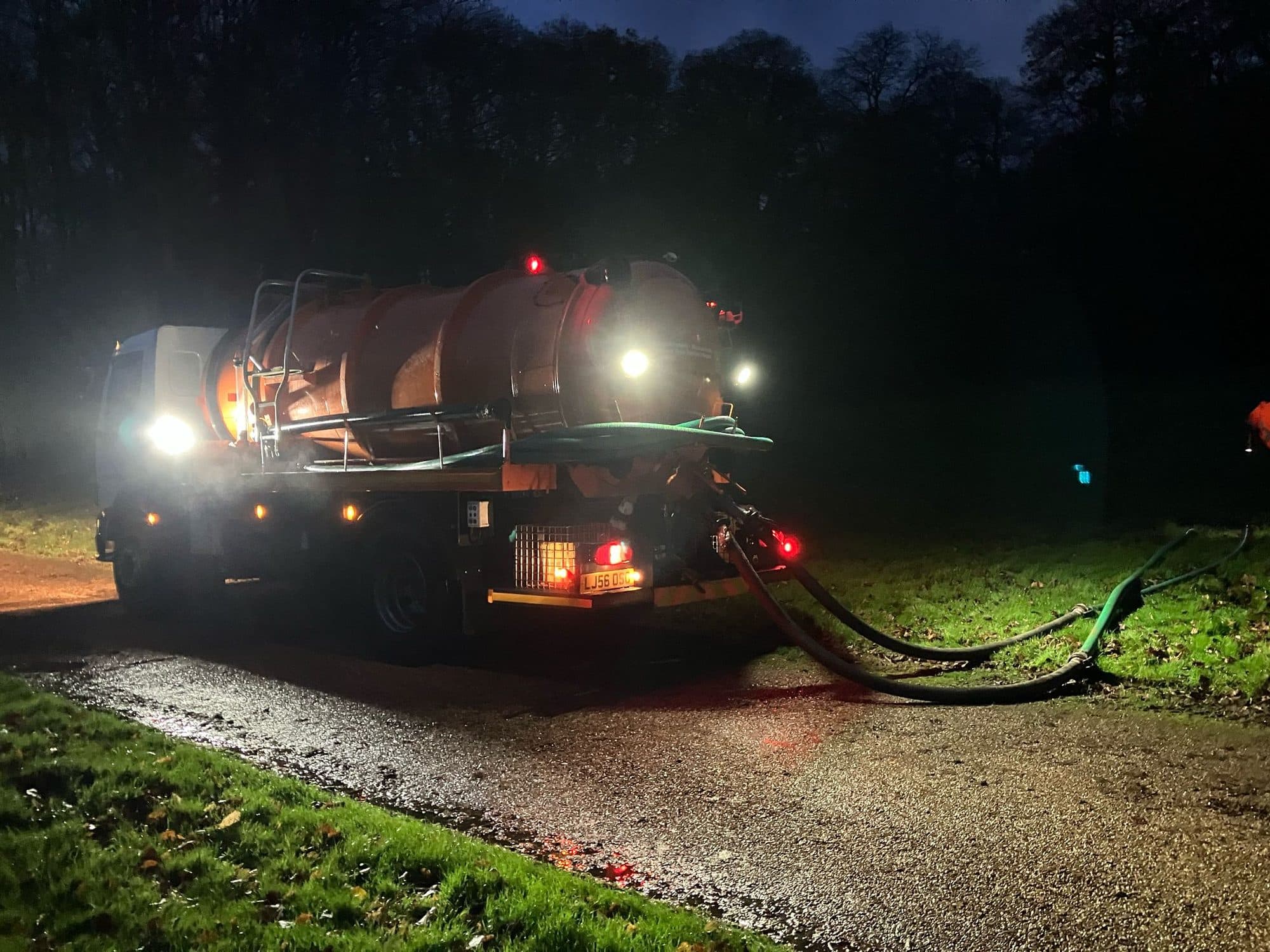
Approved Document H expects a cesspool to sit within 30 metres of vehicular access and at least 7 metres from the habitable parts of the building. The 30 metre figure is the one that matters most day to day, because it decides whether we can reach your tank from a hard surface or have to run hose across ground that will not take the weight of a loaded vehicle.
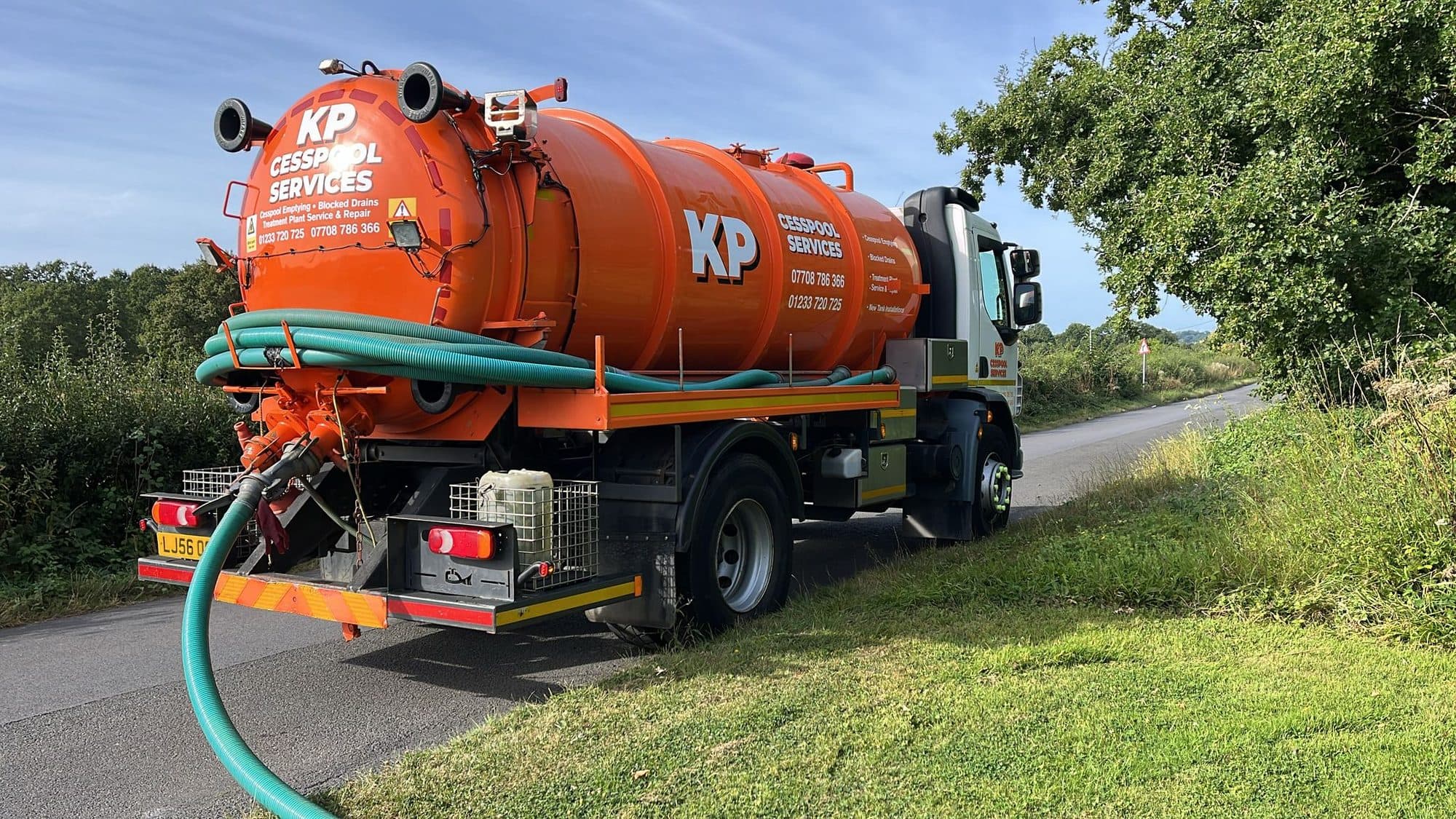
Around Rye this splits into two separate problems. In the old town, the constraint is the streets. The cobbled lanes of the Citadel were not laid out with tankers in mind, and access has to be worked out before the vehicle sets off rather than on arrival. Out on the marsh, and along the Wealden lanes towards Peasmarsh and Beckley, the constraint is ground conditions. A loaded tanker is a heavy vehicle, and a track or verge that carries a car in August will not necessarily carry a tanker in January. Where a property has a recurring access problem, a small area of hardstanding at the right distance from the tank is a one-off cost that pays for itself quickly.
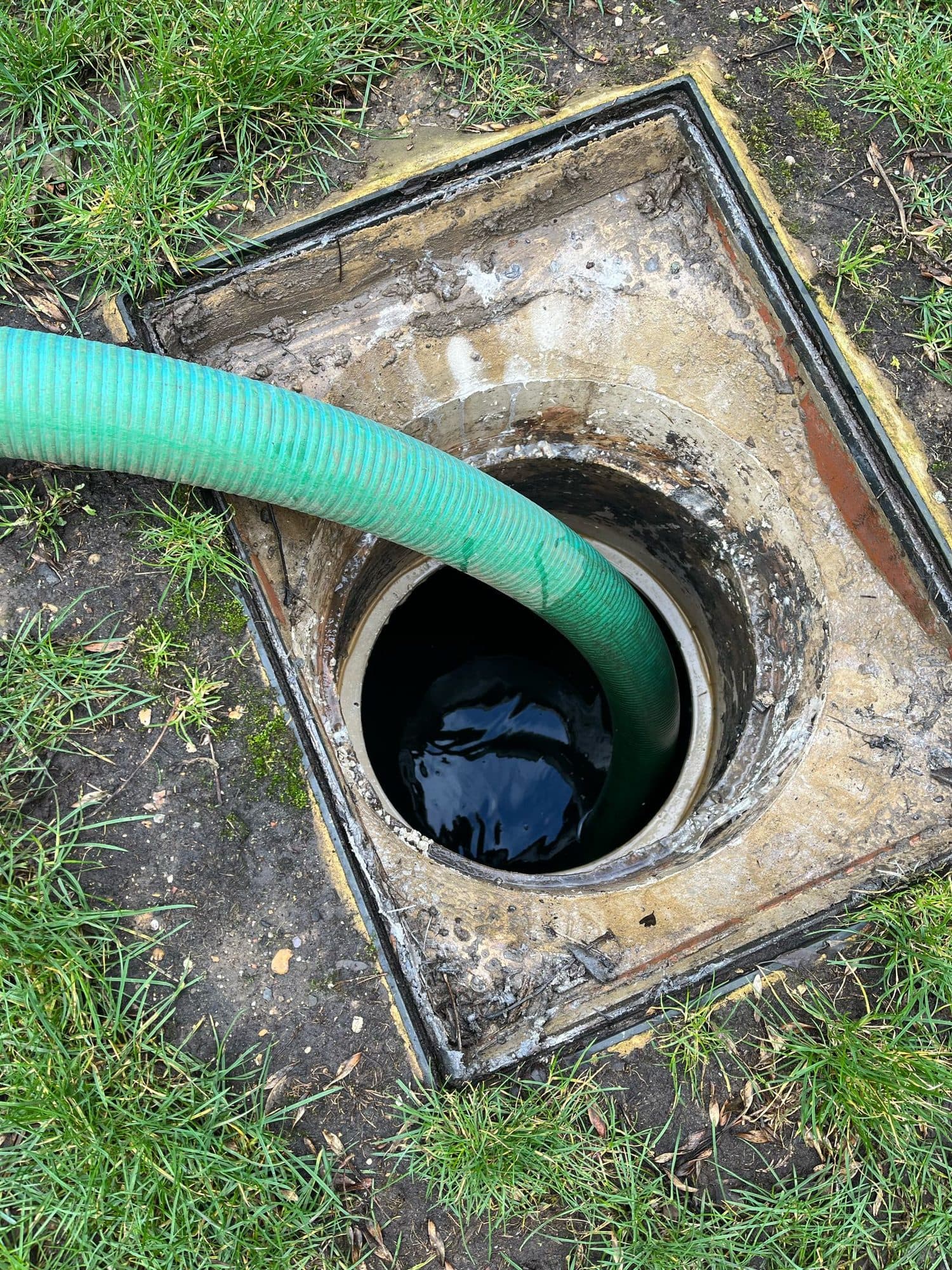
Two things make every visit faster. Keep the tank lid findable rather than buried under a decade of leaf litter, and tell us if the run from the road is longer than about 30 metres, so the right vehicle and enough hose arrive first time.
Signs your cesspool needs attention before its next visit
The most useful distinction is whether the problem sits at one fixture or across the whole property. One slow sink is a local blockage. Every drain in the house slowing together, gurgling toilets, or a smell around the tank lid or vent points at the tank itself being full, or at the pipework running into it. If it is the latter, blocked drains and tanks work and an empty may both be needed, and the order they are done in matters.
Standing water, or a soft and unusually green patch of ground over the tank, is a more serious sign, because it can mean the tank is at capacity and finding its own way out. That is not one to wait on. What happens when a cesspool overflows is not simply unpleasant, it is a pollution offence, and on ground draining towards a marsh ditch it escalates quickly.
Booking cesspool emptying in Rye
Over more than 20 years working across Kent and East Sussex, the pattern has not really changed. The properties that cause their owners the least trouble are the ones on a schedule that reflects their actual fill rate, with a tank that gets looked at rather than only pumped. Where a site allows it, we can advise on whether a treatment plant installation is a realistic alternative, though on much of the marsh the ground conditions and the designations mean it is not, and a properly sized cesspool on a sensible rota remains the right answer.
We cover Rye, Rye Harbour, Camber, Winchelsea, Playden, Iden, Peasmarsh, Beckley, Udimore and the surrounding villages, as part of our wider cesspool emptying across East Sussex. Our reviews and credentials are listed on Checkatrade. To book a scheduled visit, a one-off empty, or a 24/7 emergency callout, call 01233 720725 or email kpcesspoolservices@hotmail.com.