What a buyer's solicitor asks about a septic tank, the paperwork you need before you market the house, and the one fault that can stop a Kent sale dead.
At KP Cesspool Services, we would always rather hear from a seller early. The trouble starts when the house is already under offer, the buyer's solicitor has sent through the drainage enquiries, and the seller is finding out for the first time that nobody knows where the tank discharges or when it was last emptied. That is a fortnight of delay on a good day and a renegotiated price on a bad one. Everything below is the work that costs very little three months before you market and a great deal three weeks before completion.
Why a septic tank became a conveyancing issue
Private drainage used to barely feature in a sale. That changed with the General Binding Rules, which set out the conditions a small sewage discharge has to meet in England. The important part for a seller is that the rules make the operator of the system responsible for it, and a sale is the moment somebody finally checks.
Solicitors know this now. Where a property is not on mains drainage, drainage enquiries are standard rather than exceptional, and a buyer's lender will often want the same answers before it will release funds. A tank nobody can account for is a tank that holds up your sale.
What the rules require of you as the seller
The binding rules put one duty directly on the seller. When you sell, you must tell the buyer in writing that a sewage discharge is in place. The note should describe the system, show where its main parts and its discharge point are, list any changes made to it, and pass on the maintenance details and records, along with the manual if you have one. It is much the same information a buyer's solicitor will ask for, so preparing it once covers both.
The questions you will be asked
They vary in wording but they come down to five things.
What type of system is it, a cesspool, a septic tank or a sewage treatment plant. Where does the treated water go, to a drainage field in the ground or to a ditch or watercourse. When was it last emptied and by whom. Has it been serviced, and is there any record. And was it installed or altered recently enough to need building regulations sign off.
Answering all five with paperwork rather than recollection is the whole game. A seller who can hand over dates and receipts is a seller whose sale does not stall.
What to have ready before you market
Waste transfer notes from your last few empties, which a registered waste carrier gives you every visit. A service record if the system is a treatment plant, because a plant is machinery and a buyer will ask whether it has been maintained. Any installation paperwork you inherited when you bought. And a note of where the tank and the discharge point actually are, which sounds obvious until you try to write it down.
We are a registered waste carrier, so the transfer note comes as standard on every load. If you have used us before, ring and we will send copies of what we hold for the property.
The fault that stops sales
The one that catches people out is a septic tank discharging straight to a ditch, a stream or any other watercourse. That is not permitted, and it is not a technicality a buyer's solicitor will wave through. If your system does it, the rules say it has to be put right as soon as possible, by connecting to the public sewer where one is close enough, by fitting a drainage field so the discharge goes to ground, or by replacing the septic tank with a sewage treatment plant.
Find this out before you market and it is a job with a price on it that you can plan around. Find it out during conveyancing and it becomes a bargaining chip in somebody else's hands.
Who pays for putting it right
There is no single answer, and that is exactly why it is worth settling early. Sometimes the seller does the work before completion. Sometimes the price drops by an agreed amount and the buyer takes it on. Sometimes money is retained on completion until the work is done.
What decides it is usually who found out first and how close to exchange it surfaced. A seller who commissioned an inspection in advance is negotiating from a known number. A seller who is handed a survey finding at week six is negotiating from the buyer's estimate, and buyers' estimates are never generous.
Get it emptied and looked at first
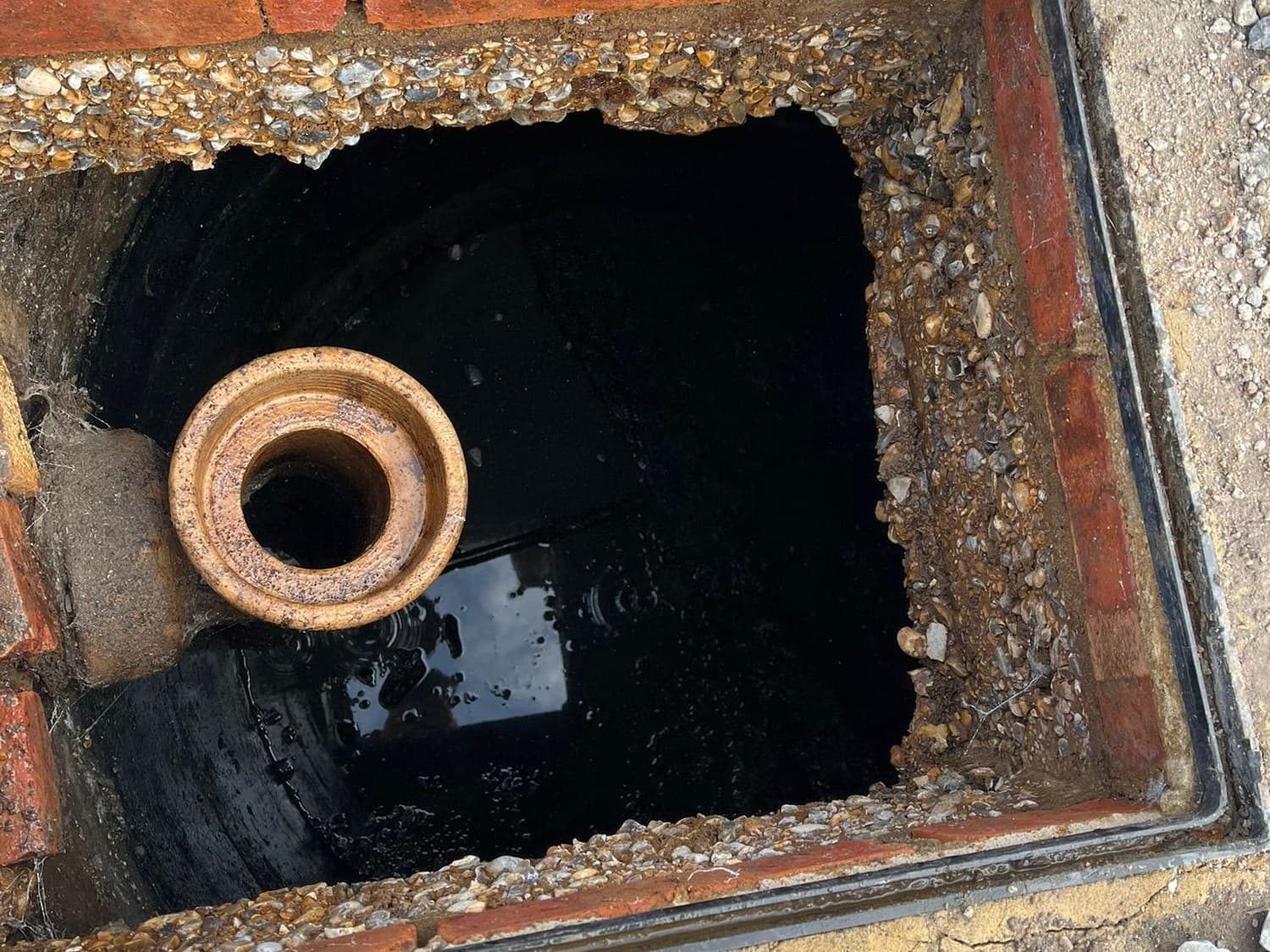
An empty and an inspection before you list is the cheapest insurance in the whole process. We lift the covers, empty the tank, measure the sludge, check the inlet, the outlet and the dip pipes, and look at how the drainage field is coping. You get a straight account of the condition and the waste transfer note for your file.
If something is failing you hear it from us, in your own time, with a cost attached. That is a completely different conversation from hearing it from a buyer's surveyor. Our septic tank servicing and septic tank emptying both cover this, and we see sellers right across Kent who want the tank emptied and looked over before the house goes on the market.
If the system genuinely needs replacing
Sometimes the honest answer is that the tank has reached the end of its life or the ground can no longer take the discharge. That is not a disaster, but it is a decision with several routes through it, and the right one depends on the ground, the space and the size of the household. We have set out the triggers and the options in when to upgrade your septic system. Installation itself is covered on our new tank installations page.
What happens if you say nothing
Do not be tempted. Property information forms ask about drainage directly, and answering them carelessly is a problem that outlives the sale. A buyer who discovers a non compliant system afterwards has a claim against the seller who told them it was fine.
The practical position is simpler than the legal one. Everything a buyer's solicitor will ask, you can find out yourself in an afternoon, for the price of an empty. Doing it early costs you a booking. Doing it late costs you leverage.
Before you call the estate agent
Book the tank in. Get the empty done, get the system looked at, and put the paperwork in the same folder as your deeds. If there is a problem you will know about it while you still have months to deal with it, and if there is not you have removed a whole category of delay from your sale.
Ring us and tell us you are selling. We will know exactly what you need.
Need a hand with yours?
We cover Kent and East Sussex 24 hours a day. Ring us and a real person will pick up, whatever time it is.